Tampilkan postingan dengan label Arctic. Tampilkan semua postingan
Tampilkan postingan dengan label Arctic. Tampilkan semua postingan
Jumat, 06 Mei 2016
Video: Into the Arctic in Norway
We'll wrap up a busy week here at The Adventure Blog with this breathtaking video. It is nearly three minutes of some of the best landscapes on Earth. Shot in the Norwegian Arctic, it shows us just how stunningly beautiful that part of the world truly is, with vistas that were meant to inspire adventures. Simply wonderful.
Norway: Into the Arctic 4K from Raphael Rogers on Vimeo.

Kamis, 05 Mei 2016
Barneo Ice Camp Closes for 2016

For the second year in a row there were now full-distance skiers to the North Pole. The logistics of such an expedition seems to be getting more challenging with each passing year, and climate change is making that journey more difficult than ever. I've said before that the toughest expedition on the planet is skiing to the North Pole, and we may actually have seen the last team to do that a few years back. Others have announced plans to attempt that journey, but no one has been able to duplicate it. That was the case this season as well with the Race Against Time squad, and I think it will probably be the same for future teams too.
2016 was a difficult year for the team that builds and operates the Barneo base as well. Not only did they have problems building and maintaining the ice runway there, they also ran into issues dealing with the Norwegian government too. The challenges with the runway were the result of the Arctic Ocean churning the increasingly thinning ice there, causing the landing strip to crack. Those problems aren't going away, and will probably continue to get worse in the years ahead.
The Barneo team has announced that they'll avoid traveling through Svalbard in Norway moving forward, and will instead use Franz Josef Land for their logistics starting in 2017. The friction with the Norwegians began when a reporter claimed that a team of Ukrainian commandos passed through Norway on their way to Barneo – something the Barneo staff denies – which calls into question whether or not the flights from Svalbard to the ice camp posed a security threat. As a result, the Norwegian government put new restrictions on the Barneo flights, which ultimately forced the change of direction for future seasons.
The 2016 Arctic season was reasonably successful with marathon runners, researchers, explorers, adventure travelers, and more passing through Barneo. Now, it'll be another year before we'll see if anyone can make the journey to the North Pole again. Good luck to the explorers aiming for that feat in 2017.
Jumat, 29 April 2016
The Last Great March Will Take Explorers Across Simpson Desert and to the North Pole

The two men – who has extensive exploration and adventure credits on their resume – first plan to set out from Ellesmere Island in Canada next February in an attempt to ski 775 km (481 miles) to the Geographic North Pole at 90ºN. They'll travel on skis over the ice, dragging their sleds filled with gear and equipment behind them as they go, with the hope of finishing the journey in under 49 days. Along the way, they'll face unpredictable weather, ice rubble fields, large open leads of water, and possibly even polar bears. If they can actually pull it off, they'll be the first team to complete the full journey to the North Pole since 2014, and quite possibly the last to do so.
But the expedition to the North Pole is only one phase of the Last Great March project. Sebastian and Mark are also planning of trekking for 520 km (323 miles) across the Simpson Desert, the driest place on the Australian continent. To do so, they'll need to pull specially built carts carrying 400 pounds (181 kg) of gear and equipment, much of which will consist of the water they'll need to survive in this inhospitable place. While out in the desert they'll face intense heat, dehydration, massive sand dunes, and a variety of poisonous snakes.
The goal of The Last Great March is to not only push the boundaries of human endurance in remote and difficult settings but also to record the impact of climate change on these places. It will be interesting to see how these expeditions play out, particularly in the Arctic. We had one team announce a full-distance expedition to the North Pole this year, and that didn't end so well. Will this team have more success next year? We'll have to wait to see.
Selasa, 26 April 2016
North Pole 2016: British Team Completes Expedition
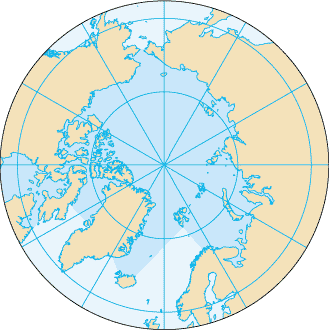
It took Mark Wood, Paul Vicary, and Mark Langridge just 4 hours to complete the final push to the Pole yesterday, facing more ice rubble and fields along the way. The squad saw plenty of that, plus plenty of other obstacles over their two weeks of skiing north, including open leads of water and blocks of ice the size of a house. They also witnessed the effects of climate change, with thinning ice, warming temperatures, and the Arctic Ocean uncovered in surpassingly large areas.
The 13-day expedition was far shorter than the trio of explorers originally envisioned. Initially the plan was to ski the full distance to the North Pole via the Russian side of the ice. Later, they decided to change directions, and travel from the Pole to Ward Hunt Island in Canada instead. But delays to the start of the expedition pushed back their start, making that much longer journey an impossibility. Instead, they elected to complete a journey that crossed two degrees of latitude instead. The shortened trip still allowed them to observe the environmental impact they had hoped to learn more about, but they had hoped to collect more data over a larger area of the Arctic.
The three men didn't spend much time at the Pole. They were picked up by helicopter last night, and flown back to the Barneo Ice Camp where they now are waiting for transportation back to Europe. It might take another day or two for that to happen, but soon they'll be on their way home.
The North Pole season will continue for another week or so as some "last degree" teams continue to ski to the Pole and some research teams wrap up their projects. Soon though, the Barneo camp will pick up for another year, and the Arctic will be abandoned once again. At this point, it is impossible not to wonder if the age of Arctic exploration is quickly coming to an end as climate change alters the landscape their forever.
Senin, 25 April 2016
North Pole 2016: British Trio Close in on 90ºN, Barneo in Transition
One of the teams that is nearing the completion of its journey is the Race Against Time squad. If all goes according to plan, polar explorers Mark Wood, Paul Vicary, and Mark Langridge should reach the North Pole sometime today. They've been closing in on the top of the world for the past few days, but the final miles haven't been easy ones. Just yesterday they faced their largest lead of open water yet, covering as many as 3 or 4 football pitches across. Those leads slow down their progress greatly, and can be dangerous to cross, but the real news here is that they are finding these areas of open water so close to the Pole. That should be one of the coldest places on Earth, and not a place where the ice is failing so quickly, but it is happening and it is going to make any future expeditions to the North Pole even more difficult, if not impossible. It won't be too long before these journeys could come to an end altogether.
Meanwhile, ExWeb is reporting that there will be no more flights to the Barneo Ice Camp from Svalbard, Norway. Instead, future flights will likely be conducted through Franz Josef Land, which is a remote Russian island. Barneo has had its share of issues being built this year thanks to the health of the ice and its movement atop the Arctic Ocean. But, it turns out there have been some political issues that also challenge the future of the temporary base, which has been in operation for 15 years.
A few weeks back, a team of Ukrainian commandos traveled to the Arctic to conduct a training exercise. Officials from Barneo say that those soldiers flew to the camp aboard a special flight that did not depart from Svalbard in Norway, which is where the majority of the commercial flights to Barneo originate. But the Norwegian government aren't convinced that that wast he case, so they revoked the flight permits citing national security. They then imposed a new set of rules that require the flights heading to Barneo to share the exact contents of its cargo, and all passengers, 48 hours before the flight. Due to the fluid nature of those flights however, Barneo officials say those requirements are impossible to meet, so future flights will no longer depart from Svalbard. That starts now, and seems likely to continue through all future operations in the Arctic as well.
This means that in addition to changing conditions in the Arctic, this shift in regulations it making it logistically more challenging to get there as well. These new flights could cost more as well, which could potentially sink some future expeditions. Traveling to the North Pole is already expensive enough, and sponsors seem more reluctant to back such a journey. This is all speculation at this point of course, and we'll have to see how this all shakes out.
Either way, its clear that operations in the Arctic for 2016 are starting to wind down now. It won't be long before Bareno is closed once again for the year.
Rabu, 20 April 2016
North Pole 2016: Barneo Ice Camp Begins Regular Operations
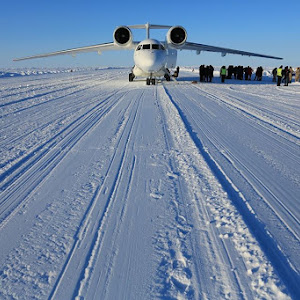
ExWeb is reporting that the runway at Barneo is complete and stable at long last, which is allowing the Russian built Antonov AN-74 aircraft to safely land and deliver important supplies and people to the Arctic. You may recall that the team of engineers who build the Barneo camp experienced issues with the blue ice landing strip, which cracked on four separate occasions, even forcing it to be relocated twice.
Amongst the groups that have now flown to Barneo so far are guided last degree ski teams that will spend the next ten days or so traveling across the frozen Arctic Ocean on their way to 90ºN. Several research teams are also out on the ice, as were Arctic marathon runners who were able to complete their race after several delays.
Because of the long delays to the start of the season, it looks like Barneo could stay open later than normal. Typically it begins to wind down operations by late April, but it is now looking like it could stay open into early May due to the backlog of people waiting to reach the ice.
Meanwhile, the Race Against Time team reports that ice conditions are now improving dramatically. They have moved away from open water and are now skiing over solid ice, which is allowing them to make better time, covering 10 nautical miles yesterday. But the continue to see foot prints from polar bears and even arctic foxes, reminding them that they are not alone out on the ice. The team is on its way to the North Pole and should arrive there late this week or early next.
Selasa, 19 April 2016
North Pole 2016: Race Against Time Team Faces Big Challenges
Last week, the team of Mark Wood, Paul Vicary, and Mark Langridge were finally dropped off on the ice after facing unprecedented delays to the start of their expedition due to issues with the runway at the Barneo Ice Camp that serves as the gateway to the Arctic each season from the Russian side of the ice. That caused the trio of explorers to rethink their journey for a second time, switching from the original plan of a full-distance ski journey to the North Pole to an expedition that actually began at 90ºN and would head south to Ward Hunt Island in Canada, before finally settling in on their current route, a two-degree ski expedition back to the Pole.
The squad has now been out on the ice for five days, and they've discovered that the Arctic is everything they had expected and more. In the first few days they faced rubble fields of disrupted ice, with many blocks the size of cars and even a few larger than a house. As they inched north however, other obstacles have begun to appear. For instance, yesterday the team only gained 4 nautical miles of distance thanks to a large lead of open water that they had to cross. The only way to do so is to don drysuits, enter the water and swim across while pulling their gear in inflatable rafts.
As if that wasn't enough, the men have also come across a set of footprints left behind by a polar bear. That means that one of these big carnivores is in the area, and they have been known to stalk polar explorers that pass through their domain. So far, no sight of the creature but they will remain wary and vigilant on the trail.
The hope is that the team can reach the North Pole sometime next week. When they originally set out, they thought it would take 12-15 days, and they are still on track to reach their goal. What else they'll find on the way north remains to be seen.
Kamis, 14 April 2016
North Pole 2016: Race Against Time Team Changes Direction Again, Delays at Barneo Continue
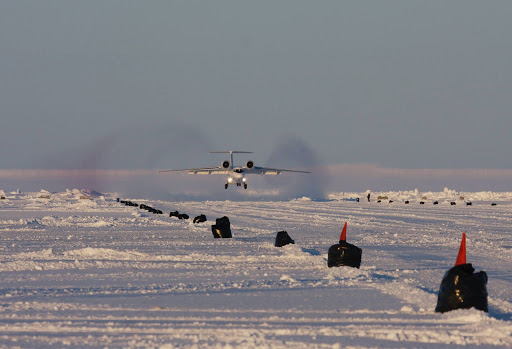
First, an update on the Race Against Time team, which was finally dropped off on the ice yesterday, although they have once against changed direction due to their shortened window for skiing across the Arctic. Originally the plan was for British explorers Mark Wood, Paul Vicary, and Mark Langridge to ski from the Russian side of the Arctic Ocean to the North Pole. When that route started look tenuous, they elected to change their plans and fly to the North Pole to ski south to Ward Hunt Island in Canada instead.
Now, thanks to all of the delays in flights and at the Barneo camp, the team has roughly two weeks to conduct their expedition. This has caused them to switch their plans once again, now skiing the final two degrees to the North Pole instead. The trio were dropped at 88ºN yesterday, and will now spend the next 12-15 days skiing to the top of the world. Along the way they'll conduct research on the impact of climate change on the Arctic while documenting current conditions there.
Meanwhile, the team of engineers at Barneo have now completed their fourth runway made of blue ice. The previous landing strips suffered cracks due to the movement of the ice, making them unsafe for incoming flights. The team was in desperate need of resupply, and immediately called for a large aircraft to bring them food and fuel.
But after that flight, the first aircraft carrying skiers, explorers, researchers, and other people was scheduled to take off in an attempt to get things back on schedule in the Arctic. Unfortunately, the Norwegian government scrubbed that flight and required the Barneo team to fill out permits for all 11 flights that they had already scheduled. This paperwork has caused further delays, but the first five flights are now on the docket with the others to follow.
It seems highly likely that Barneo will stay in operation for longer than usual. Typically it begins to wrap up operations in late April, but with these long delays it seems the Arctic season will probably stretch into May. How this will impact travel there remains to be seen, but with the spring melt already underway, it seems likely that this will continue to be a very unusual year indeed.
Selasa, 12 April 2016
North Pole 2016: Race Against Time Team Finally Set to Depart, Runway Issues Persist at Barneo
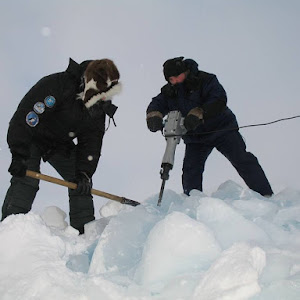
The Race Against Time team, which consists of Mark Wood, Paul Vicary, and Mark Langridge, have confirmed that they are now preparing to leave for Barneo, where they will immediately hop onto a helicopter and fly out to the frozen Arctic Ocean to start their expedition. They will have approximately 20 days to ski as far as they can towards the Canadian coastline, at which point they will have to be retrieved from the ice, which could be a difficult proposition on its own.
This is a very truncated version of their original plans, which saw them skiing for hundreds of miles across the Arctic Ocean to reach remote Ward Hunt Island. Their plan is to document the impact of climate change on the region, while perhaps undertaking the final full-length ski journey from the North Pole. But now, they'll try to ski as far as possible while staying true to their initial expedition goals.
Meanwhile, ExWeb reports that the new runway at the relocated Barneo camp continues to crack under the movement of the ice. This second base is not proving to be much more reliable than the original, but a new location for the landing strip has been found and construction has already begun. Emergency supplies have also been shipped to the Ice Camp to help keep the team up and running while they wait for the regular supply planes to begin arriving. There is also word that the season could be extended into May in order to accommodate all of the teams that are hoping to get some time in the Arctic or at the North Pole this season. Right now, all of those men and women are stacked up, waiting for flights to resume. Already days behind schedule, they are of course starting to get anxious.
Hopefully the flights to Barneo will start to get back on schedule soon. I'll continue to share updates on the North Pole season as it begins to unfold.
Senin, 11 April 2016
Video: Nat Geo Photographer Captures the Wildlife of the Arctic
Think the Arctic is lifeless? Think again. In this video, we travel north with National Geographic photographer Vincent Munier, who visits the frozen landscapes of our planet to shoot the amazing wildlife that is found there. He captures great photos of wolves, foxes, arctic hares, owls, and of course polar bears. Munier has compiled many of these images in his book Arctique.
Jumat, 08 April 2016
North Pole 2016: Second Barneo Location Suffers Cracked Runway Too

ExWeb reports that the Barneo staff indicated that a 10 cm (4 inch) crack opened in the ice along the new runway, which had already had 400 meters built. The team was evaluating whether or not that crack could be repaired, while also indicating that its search helicopters were already back in the air looking for other ice flows that could serve as a new location for the base.
So what's the problem this year? It is a combination of things. For starters, the Arctic ice levels are at near record lows, indicating that the thickness is not what it has been in the past. On top of that, there are currently some massive sea currents (Exweb calls it an "anticyclone) that is moving the ice, causing it to break and crack. This has made things less stable, and is making it more difficult for the Russian team to find a suitable place to serve as the staging ground for the North Pole season.
meanwhile, back in Longyearbyen, Norway there are teams of explorers, researchers, scientists, and adventure travelers who are waiting to travel to the Arctic. Unfortunately, they can't go anywhere at the moment, as Barneo is not ready to receive them. That means they have to sit and wait, hoping that eventually they'll get a chance to start their expeditions. At this point, that might not happen for another week, greatly delaying their progress.
The team that is most effected by these delays is the British Race Against Time squad. They had intended to ski from the North Pole to Ward Hunt Island in Canada. Originally they had 35 days to complete that dangerous journey. Now, they've seen that number reduced dramatically, and the entire expedition is probably in jeopardy. The team headed out on a training session that will last a few days while they waited for news on the construction of a new runway. Now, they're more than likely rethinking their plans, and possibly postponing until next year. We'll have to wait to see if that is the case.
For now, like everyone else, we wait.
Rabu, 06 April 2016
North Pole 2016: Barneo Ice Camp to be Relocated After Runway Failure

ExWeb says that just 650 meters of the runway still exists following the damage inflicted by the arrival of the first AN-74 aircraft. That's a big, heavy plane that not only has a long range, but also the ability to carry a lot of gear and equipment too. Those planes are the workhorse at Barneo, delivering explorers, adventurers, scientists, and researchers to the Arctic.
Upon determining that the runway was beyond repair, the team that builds the ice camp immediately began searching for a suitable replacement. They found another ice flow within a few hours, and began the process of moving the base and creating a new landing strip. Unfortunately, that process will take 7-8 days to complete, which means that some Arctic expeditions will be delayed or may have to be cancelled altogether.
One such team that we've been following closely is the Race Against Time expedition, which was to have been underway by now. The plan was for three British explorers – Mark Wood, Paul Vicary, and Mark Langridge – to ski from the North Pole to Ward Hunt Island in Canada. That journey was expected to take a minimum of 35 days through tough conditions. Now, the team will have just 20 days to cover as much ground as they can.
According to reports on their website, the team will still embark on their mission to cross the Arctic, documenting the impact of climate change as they go. But they now know that they'll never reach the Canadian coast before conditions begin to deteriorate in the Arctic Ocean, as warmer temperatures and spring weather begins to take its toll. Instead, they'll ski as far as they can and be picked up by an icebreaker ship. They plan to be on the first flight out to the new Barneo Ice Camp once it is established, and will move on to the North Pole soon there after.
The failure of the runway at Barneo is another indication that the Arctic is warming. The privately built camp has been operating in the Arctic for years, and have only had one other instance when the runway cracked. But as temperatures rise, the ability to travel in the Arctic will become compromised, and possibly even more dangerous. How this will impact future trips to the region remains to be seen, but it seems that the location of future Barneo camps will need to be selected very carefully.
For now, the 2016 North Pole season is at a standstill. Stay tuned for more updates in a few days.
Selasa, 05 April 2016
North Pole 2016: Runway at Barneo Ice Camp Cracks, Delaying Access to the Arctic
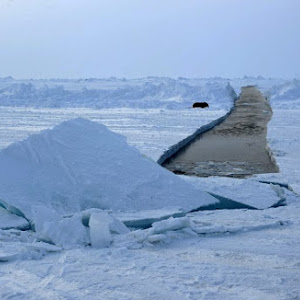
For those not familiar with Barneo, it is a temporary base that is constructed in the Arctic Ocean each year by a team of Russian engineers. They first locate a large ice flow that can support the camp, and a construction crew parachutes onto that location to begin building a runway and setting up the basic structures. Later, larger aircraft arrive bringing more supplies, tents, and other equipment.
That same process was underway this season, with the Barneo camp coming together mostly on schedule. But according to ExWeb the arrival of the first AN-74 aircraft – a large and heavy Russian plane – cracked the landing strip, delaying the arrival of any more aircraft and leaving teams of skiers, explorers, and researchers stranded in Norway awaiting transfer to the base.
Fortunately, repairs are already underway, and the weather is lending a hand. Temperatures at Barneo are said to be in the -25ºF/-32ºC range, and crews there are pouring water into the cracks on the runway to help repair it. Reportedly, the team has also adjusted the direction of the airport slightly to help compensate for any potential issues.
If all goes according to plan, the repairs should be complete today, and flights will resume as early as tonight. The Race Against Time team should be on the next flight, and will hopefully be shuttled on to the North Pole shortly there after.
The 2016 North Pole season will not be a very busy one, but it should still be interesting. Stay tuned for update once it actually gets underway.
Senin, 04 April 2016
British Team Heads to the North Pole

Arctic explorers Mark Wood, Paul Vicary, and Mark Langridge checked in a few days back from Svalbard in Norway, where they were awaiting a flight to Barneo. That flight was expected to take place this past Saturday, but as of now there has been no confirmation that they have reached the temporary ice base which will grant them access to the North Pole.
The team hopes to travel on foot from 90ºN to the Canadian coast at Ward Hunt Island, covering a total of 470 nautical miles (540 miles/870 km) in the process. They had estimated that it would take about 35 days to achieve that goal, but that was also with a projected start date of April 1. Now, three days after that deadline they're still waiting to get underway, which could prevent them from successfully completing the journey as their travel window begins to narrow, and eventually close.
According to the team's most recent update on Facebook, their flight out to Barneo has once again been delayed. The three men remain in Norway, packed and ready to go. But the longer they are delayed, the more difficult their expedition becomes. Once they reach Barneo, it is a relatively short flight by helicopter to their starting point. That means that they could potentially catch a lift to the North Pole as early as tomorrow, but further delays will only make the situation worse.
I have been following the Race Against Time team since their expedition was first announced last fall. During that time, the objectives have changed, but the resolve of the explorers has remained the steadfast. I'm sure they're all eager to get started, but their patience is definitely being tested at the moment. Hopefully there will be good news soon.
Stay tuned for more updates on this expedition in the days ahead.
Senin, 28 Maret 2016
Russian Team Designs Vehicle to Drive to the North Pole
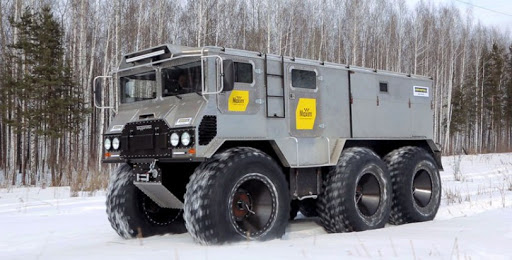
ExWeb has the scoop on this amazing looking new vehicle designed and built by Alexey Makarov. The Russian explorer has a history of creating such trucks, having designed previous vehicles that have been used on motorized expeditions into the Arctic and all the way to 90ºN. Those other models were used in expeditions in both 2009 and 2013.
The Burlak weighs 4 tons and is more than 6 meters (19.6 ft.) in length. It stands 3.2 meters (10.5 ft) high and 2.9 meters (9.5 ft) wide. It is based on a Russian amphibious military vehicle called the BTR-60 and the Toyota Land Cruiser, although ExWeb says that the transmission and transfer case are completely unique. The cabin of the Burlak includes four beds, a kitchen, a sink, and a shower. It has also been insulated with special materials and it pipes heat from the engine into the interior to help keep it warmer.
Makarov says that he built on his previous experience driving through the Arctic, creating a more safe and secure truck for such motorized expeditions. He is currently testing the prototype model of the Burlak by driving from the coast of the Kara Sea, through the Russian Arctic, and ending at Baidarata Bay. Another model of the truck is expected to be built following this rolling test.
Then, in 2017 the two vehicles will be driven to the Russian polar station located on Severnaya Zemlya Archipelago in anticipation for the start of their first true test in the Arctic – a 2018 drive to the North Pole and back again from the Russian side of the ice.
The fact that this vehicle can cross open water, drive on rugged terrain and ice, and survive in the extremely cold temperatures of the Arctic makes it an intriguing expedition option indeed. It's still two years away from taking off on its journey, but it should be fun to see how it performs when it does.
Who else wants one of these?
Jumat, 25 Maret 2016
Video: From Sea to Summit in Norway
Last spring, Colombian adventurer Douglas Del Castillo and dutch climber and adventure racer Wouter Huitzing set out on quite an expedition. The plan was to travel completely self-supported above the Arctic Circle in Norway, going from sea level into the high mountains found there. The duo found plenty of challenges to overcome along the way, but those difficulties were over shadowed by the amazing landscapes they discovered there. This video takes us along with them into the Norwegian wilds to get a small taste of this wonderful adventure.
Langganan:
Postingan (Atom)