For a lot of people, climbing Mt. Everest is the dream of a lifetime. But thinking about everything that goes into preparing and planning for such an expedition can be overwhelming. Fortunately, Men's Journal is here to help, giving us a three-year plan to making Everest not just a dream, but a reality.
MJ's article was actually written back in 2014, with the plan of reaching the summit of Everest in the spring of 2017. But, if you ignore the precise dates, and focus just on the plan itself, the schedule can remain the same. And fortunately for all of us, the training starts in May.
The first stage of the Everest prep plan is to start getting into shape. The article says that you should start getting ready by building a strong fitness base of cardio, strength, and balance. Over the course of the three year program, that will be the focus of getting your body ready for the challenges of the Himalaya.
Next up, you'll also need to start seeing how your body does at altitude, so the plan is to bag a 14er, or a fourteen-thousand foot peak. This will not only allow you to put your fitness gains to the test, it'll let you build leg strength and lung capacity. With its 53 different 14ers, Colorado is a natural destination to bag one of these mountains, but there are plenty of others around as well.
The rest of the plan includes pushing your physical boundaries even higher by attempting more challenging peaks (Mt. Rainier for instance) and adding altitude. The Men's Journal schedule recommends traveling to Ecuador to climb Cotopaxi to get a taste for altitudes above 19,000 feet, although Tanzania's Kilimanjaro will do too. From there, it's on to Denali in Alaska – described as a "mini-Everest" – before attempting an easier 8000-meter peak like Cho Oyu. After that, Everest will be in reach.
In terms of creating a strategy for getting yourself ready to climb the Big Hill, this is about as good of a plan as any. You could literally go from zero mountaineering experience, to Everest in just three years if you stick to the schedule closely. What it doesn't offer is advice on how to pay for it all. Mountaineering expeditions aren't cheap, and even travel to and from these locations can be pricey. For most of us, that would turn this three year plan into one that would probably take a decade or more to wrap up.
Tampilkan postingan dengan label Expedition. Tampilkan semua postingan
Selasa, 03 Mei 2016
Jumat, 29 April 2016
The Last Great March Will Take Explorers Across Simpson Desert and to the North Pole
As the 2016 Arctic exploration season starts to wind down, we now get word of yet another attempt to ski the full distance to the North Pole. Adventurers Sebastian Copeland and Mark George are planning on making that journey in 2017 as part of what they call The Last Great March, a project that also includes a self-supported journey across Australia's Simpson Desert as well.
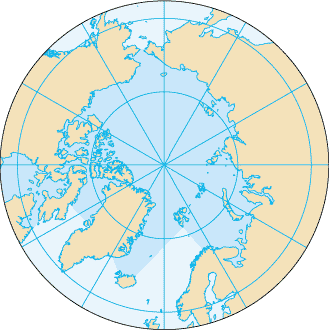
The two men – who has extensive exploration and adventure credits on their resume – first plan to set out from Ellesmere Island in Canada next February in an attempt to ski 775 km (481 miles) to the Geographic North Pole at 90ºN. They'll travel on skis over the ice, dragging their sleds filled with gear and equipment behind them as they go, with the hope of finishing the journey in under 49 days. Along the way, they'll face unpredictable weather, ice rubble fields, large open leads of water, and possibly even polar bears. If they can actually pull it off, they'll be the first team to complete the full journey to the North Pole since 2014, and quite possibly the last to do so.
But the expedition to the North Pole is only one phase of the Last Great March project. Sebastian and Mark are also planning of trekking for 520 km (323 miles) across the Simpson Desert, the driest place on the Australian continent. To do so, they'll need to pull specially built carts carrying 400 pounds (181 kg) of gear and equipment, much of which will consist of the water they'll need to survive in this inhospitable place. While out in the desert they'll face intense heat, dehydration, massive sand dunes, and a variety of poisonous snakes.
The goal of The Last Great March is to not only push the boundaries of human endurance in remote and difficult settings but also to record the impact of climate change on these places. It will be interesting to see how these expeditions play out, particularly in the Arctic. We had one team announce a full-distance expedition to the North Pole this year, and that didn't end so well. Will this team have more success next year? We'll have to wait to see.
The two men – who has extensive exploration and adventure credits on their resume – first plan to set out from Ellesmere Island in Canada next February in an attempt to ski 775 km (481 miles) to the Geographic North Pole at 90ºN. They'll travel on skis over the ice, dragging their sleds filled with gear and equipment behind them as they go, with the hope of finishing the journey in under 49 days. Along the way, they'll face unpredictable weather, ice rubble fields, large open leads of water, and possibly even polar bears. If they can actually pull it off, they'll be the first team to complete the full journey to the North Pole since 2014, and quite possibly the last to do so.
But the expedition to the North Pole is only one phase of the Last Great March project. Sebastian and Mark are also planning of trekking for 520 km (323 miles) across the Simpson Desert, the driest place on the Australian continent. To do so, they'll need to pull specially built carts carrying 400 pounds (181 kg) of gear and equipment, much of which will consist of the water they'll need to survive in this inhospitable place. While out in the desert they'll face intense heat, dehydration, massive sand dunes, and a variety of poisonous snakes.
The goal of The Last Great March is to not only push the boundaries of human endurance in remote and difficult settings but also to record the impact of climate change on these places. It will be interesting to see how these expeditions play out, particularly in the Arctic. We had one team announce a full-distance expedition to the North Pole this year, and that didn't end so well. Will this team have more success next year? We'll have to wait to see.
Rabu, 27 April 2016
Video: 5 Things to Know Before You Go on an Adventure
Before you set out on your next adventure, you'll want to watch this video. It comes our way from National Geographic, and it shares advice that a team of climbers learned while traveling to Myanmar to climb the highest peak in Southeast Asia. That expedition wasn't an easy one, with lots of challenges to overcome before they ever reached the mountain. But what they learned along the way was invaluable.
Selasa, 26 April 2016
North Pole 2016: British Team Completes Expedition
As expected, the British Race Against Time team completed its journey yesterday, reaching the North Pole after 13 days out on the ice. The Pole marked the finish line for what was a demanding trek that began long before they ever set foot in the Arctic, and culminated at 90ºN early yesterday.
It took Mark Wood, Paul Vicary, and Mark Langridge just 4 hours to complete the final push to the Pole yesterday, facing more ice rubble and fields along the way. The squad saw plenty of that, plus plenty of other obstacles over their two weeks of skiing north, including open leads of water and blocks of ice the size of a house. They also witnessed the effects of climate change, with thinning ice, warming temperatures, and the Arctic Ocean uncovered in surpassingly large areas.
The 13-day expedition was far shorter than the trio of explorers originally envisioned. Initially the plan was to ski the full distance to the North Pole via the Russian side of the ice. Later, they decided to change directions, and travel from the Pole to Ward Hunt Island in Canada instead. But delays to the start of the expedition pushed back their start, making that much longer journey an impossibility. Instead, they elected to complete a journey that crossed two degrees of latitude instead. The shortened trip still allowed them to observe the environmental impact they had hoped to learn more about, but they had hoped to collect more data over a larger area of the Arctic.
The three men didn't spend much time at the Pole. They were picked up by helicopter last night, and flown back to the Barneo Ice Camp where they now are waiting for transportation back to Europe. It might take another day or two for that to happen, but soon they'll be on their way home.
The North Pole season will continue for another week or so as some "last degree" teams continue to ski to the Pole and some research teams wrap up their projects. Soon though, the Barneo camp will pick up for another year, and the Arctic will be abandoned once again. At this point, it is impossible not to wonder if the age of Arctic exploration is quickly coming to an end as climate change alters the landscape their forever.
It took Mark Wood, Paul Vicary, and Mark Langridge just 4 hours to complete the final push to the Pole yesterday, facing more ice rubble and fields along the way. The squad saw plenty of that, plus plenty of other obstacles over their two weeks of skiing north, including open leads of water and blocks of ice the size of a house. They also witnessed the effects of climate change, with thinning ice, warming temperatures, and the Arctic Ocean uncovered in surpassingly large areas.
The 13-day expedition was far shorter than the trio of explorers originally envisioned. Initially the plan was to ski the full distance to the North Pole via the Russian side of the ice. Later, they decided to change directions, and travel from the Pole to Ward Hunt Island in Canada instead. But delays to the start of the expedition pushed back their start, making that much longer journey an impossibility. Instead, they elected to complete a journey that crossed two degrees of latitude instead. The shortened trip still allowed them to observe the environmental impact they had hoped to learn more about, but they had hoped to collect more data over a larger area of the Arctic.
The three men didn't spend much time at the Pole. They were picked up by helicopter last night, and flown back to the Barneo Ice Camp where they now are waiting for transportation back to Europe. It might take another day or two for that to happen, but soon they'll be on their way home.
The North Pole season will continue for another week or so as some "last degree" teams continue to ski to the Pole and some research teams wrap up their projects. Soon though, the Barneo camp will pick up for another year, and the Arctic will be abandoned once again. At this point, it is impossible not to wonder if the age of Arctic exploration is quickly coming to an end as climate change alters the landscape their forever.
Rabu, 20 April 2016
North Pole 2016: Barneo Ice Camp Begins Regular Operations
It has been a challenging season in the Arctic so far with lots of delays for the explorers, researchers, and adventurers who planned to travel their this year. The Barneo Ice Camp, a temporary base built at roughly 89ºN each spring has experienced its share of issues, which resulted in some unprecedented delays to the start of the season. But now, things are finally back on track and regular flights have resumed, as support teams race to complete a busy schedule as quickly as possible.
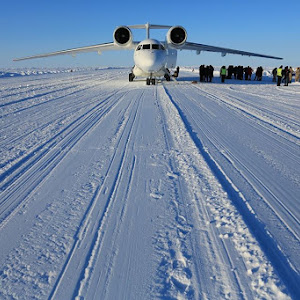
ExWeb is reporting that the runway at Barneo is complete and stable at long last, which is allowing the Russian built Antonov AN-74 aircraft to safely land and deliver important supplies and people to the Arctic. You may recall that the team of engineers who build the Barneo camp experienced issues with the blue ice landing strip, which cracked on four separate occasions, even forcing it to be relocated twice.
Amongst the groups that have now flown to Barneo so far are guided last degree ski teams that will spend the next ten days or so traveling across the frozen Arctic Ocean on their way to 90ºN. Several research teams are also out on the ice, as were Arctic marathon runners who were able to complete their race after several delays.
Because of the long delays to the start of the season, it looks like Barneo could stay open later than normal. Typically it begins to wind down operations by late April, but it is now looking like it could stay open into early May due to the backlog of people waiting to reach the ice.
Meanwhile, the Race Against Time team reports that ice conditions are now improving dramatically. They have moved away from open water and are now skiing over solid ice, which is allowing them to make better time, covering 10 nautical miles yesterday. But the continue to see foot prints from polar bears and even arctic foxes, reminding them that they are not alone out on the ice. The team is on its way to the North Pole and should arrive there late this week or early next.
ExWeb is reporting that the runway at Barneo is complete and stable at long last, which is allowing the Russian built Antonov AN-74 aircraft to safely land and deliver important supplies and people to the Arctic. You may recall that the team of engineers who build the Barneo camp experienced issues with the blue ice landing strip, which cracked on four separate occasions, even forcing it to be relocated twice.
Amongst the groups that have now flown to Barneo so far are guided last degree ski teams that will spend the next ten days or so traveling across the frozen Arctic Ocean on their way to 90ºN. Several research teams are also out on the ice, as were Arctic marathon runners who were able to complete their race after several delays.
Because of the long delays to the start of the season, it looks like Barneo could stay open later than normal. Typically it begins to wind down operations by late April, but it is now looking like it could stay open into early May due to the backlog of people waiting to reach the ice.
Meanwhile, the Race Against Time team reports that ice conditions are now improving dramatically. They have moved away from open water and are now skiing over solid ice, which is allowing them to make better time, covering 10 nautical miles yesterday. But the continue to see foot prints from polar bears and even arctic foxes, reminding them that they are not alone out on the ice. The team is on its way to the North Pole and should arrive there late this week or early next.
Selasa, 19 April 2016
North Pole 2016: Race Against Time Team Faces Big Challenges
After overcoming a series of challenges just to get to the starting line, the Race Against Time team is now out on the Arctic ice and making their way towards the North Pole. But as expected, this journey to the top of the world hasn't been an easy one so far as a number of natural obstacles force the team to earn every mile.
Last week, the team of Mark Wood, Paul Vicary, and Mark Langridge were finally dropped off on the ice after facing unprecedented delays to the start of their expedition due to issues with the runway at the Barneo Ice Camp that serves as the gateway to the Arctic each season from the Russian side of the ice. That caused the trio of explorers to rethink their journey for a second time, switching from the original plan of a full-distance ski journey to the North Pole to an expedition that actually began at 90ºN and would head south to Ward Hunt Island in Canada, before finally settling in on their current route, a two-degree ski expedition back to the Pole.
The squad has now been out on the ice for five days, and they've discovered that the Arctic is everything they had expected and more. In the first few days they faced rubble fields of disrupted ice, with many blocks the size of cars and even a few larger than a house. As they inched north however, other obstacles have begun to appear. For instance, yesterday the team only gained 4 nautical miles of distance thanks to a large lead of open water that they had to cross. The only way to do so is to don drysuits, enter the water and swim across while pulling their gear in inflatable rafts.
As if that wasn't enough, the men have also come across a set of footprints left behind by a polar bear. That means that one of these big carnivores is in the area, and they have been known to stalk polar explorers that pass through their domain. So far, no sight of the creature but they will remain wary and vigilant on the trail.
The hope is that the team can reach the North Pole sometime next week. When they originally set out, they thought it would take 12-15 days, and they are still on track to reach their goal. What else they'll find on the way north remains to be seen.
Last week, the team of Mark Wood, Paul Vicary, and Mark Langridge were finally dropped off on the ice after facing unprecedented delays to the start of their expedition due to issues with the runway at the Barneo Ice Camp that serves as the gateway to the Arctic each season from the Russian side of the ice. That caused the trio of explorers to rethink their journey for a second time, switching from the original plan of a full-distance ski journey to the North Pole to an expedition that actually began at 90ºN and would head south to Ward Hunt Island in Canada, before finally settling in on their current route, a two-degree ski expedition back to the Pole.
The squad has now been out on the ice for five days, and they've discovered that the Arctic is everything they had expected and more. In the first few days they faced rubble fields of disrupted ice, with many blocks the size of cars and even a few larger than a house. As they inched north however, other obstacles have begun to appear. For instance, yesterday the team only gained 4 nautical miles of distance thanks to a large lead of open water that they had to cross. The only way to do so is to don drysuits, enter the water and swim across while pulling their gear in inflatable rafts.
As if that wasn't enough, the men have also come across a set of footprints left behind by a polar bear. That means that one of these big carnivores is in the area, and they have been known to stalk polar explorers that pass through their domain. So far, no sight of the creature but they will remain wary and vigilant on the trail.
The hope is that the team can reach the North Pole sometime next week. When they originally set out, they thought it would take 12-15 days, and they are still on track to reach their goal. What else they'll find on the way north remains to be seen.
Kamis, 14 April 2016
The Explorers Museum Announces 2016 Summit in Ireland
The Explorers Museum, a not for profit organization dedicated to promoting the continuing exploration of our planet through the recognition of significant expeditions, discoveries and explorers, has announced the dates and line-up for its 2016 weekend summit. The event will take place June 24-25 in Tullamore, Ireland at the museum's headquarters in Charleville Castle, where a host of luminaries will be on hand.
In the modern age, exploration is no longer just about important firsts and filling in the blank spots on the map. As The Explorers Museum recognizes there is a great deal of effort being put into learning about sustainability, preserving the planet, and making it a better place for those of us who inhabit it. To that end, the list of guests who will be attending the summit reflects these values. Additionally, the theme of the entire weekend is "Redefining Exploration," which indicates what the keynote address and sessions will be about.
You can read more about the summit weekend, check out the full line-up, and purchase tickets here. Glancing over the schedule, some of the highlights include opening ceremonies that include an address from Lorie Karnath – former President of the Explorers Club and founder of The Explorers Museum. There will also be a screening of the film Racing Extinction, breakout sessions that focus on fieldwork, climate change, the changing nature of exploration, and much more.
Tickets are on sale now, and it looks like this will be a very interesting weekend for those of us who value exploration in the 21st century. The setting at Charleville Castle – the Global Expedition Base – will serve as a fantastic backdrop to these discussions. I know I'd love to be there.
In the modern age, exploration is no longer just about important firsts and filling in the blank spots on the map. As The Explorers Museum recognizes there is a great deal of effort being put into learning about sustainability, preserving the planet, and making it a better place for those of us who inhabit it. To that end, the list of guests who will be attending the summit reflects these values. Additionally, the theme of the entire weekend is "Redefining Exploration," which indicates what the keynote address and sessions will be about.
You can read more about the summit weekend, check out the full line-up, and purchase tickets here. Glancing over the schedule, some of the highlights include opening ceremonies that include an address from Lorie Karnath – former President of the Explorers Club and founder of The Explorers Museum. There will also be a screening of the film Racing Extinction, breakout sessions that focus on fieldwork, climate change, the changing nature of exploration, and much more.
Tickets are on sale now, and it looks like this will be a very interesting weekend for those of us who value exploration in the 21st century. The setting at Charleville Castle – the Global Expedition Base – will serve as a fantastic backdrop to these discussions. I know I'd love to be there.
Langganan:
Postingan (Atom)